Just arriving in Ho Chi Minh City was a bit of a culture shock. Even though we had been in bigger cities (Siem Reap, Phnom Penh, etc…) the look and feel were very different than what we were greeted by in Ho Chi Minh. From our hostel, we ventured out to find food and found a street bursting with people, lights, and noise to the point that we could barely process it all. But once we settled in, we continued our few days of heavy history and education. Our first stop was the Cu Chi Tunnels.
From everything we read online, it looked like the “best” way to explore the tunnels was to try to go independently. However, the cab fare alone to get out there would have been pricey. Our hostel seemed to be offering small group tours for a very reasonable price, so we booked a trip with them. Turned out that our small group, joined another small group, and another until we were part of a busload of tourists. On top of that, our guide was a jerk. However this site is fascinating and definitely worth a tour. Just make sure you know what you are getting when you sign up.
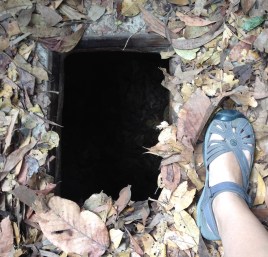
Anyway – the Cu Chi Tunnels is the tunnel system used by the Vietnamese during the Vietnam War (to them, the American War). These tunnels provided a stealthy way to move around dangerous battlegrounds as well as provided protection from enemy (US) bombs and air raids. Entire communities would do everything from cooking to weapon making underground, in tunnels that seemed barely big enough for small children. Seriously — look at the size of that tunnel entrance. I think I might have been able to squeeze through, but I would not have been happy about it.
The tunnels we were able to walk through have been expanded for tourists, and are still too small for some people.
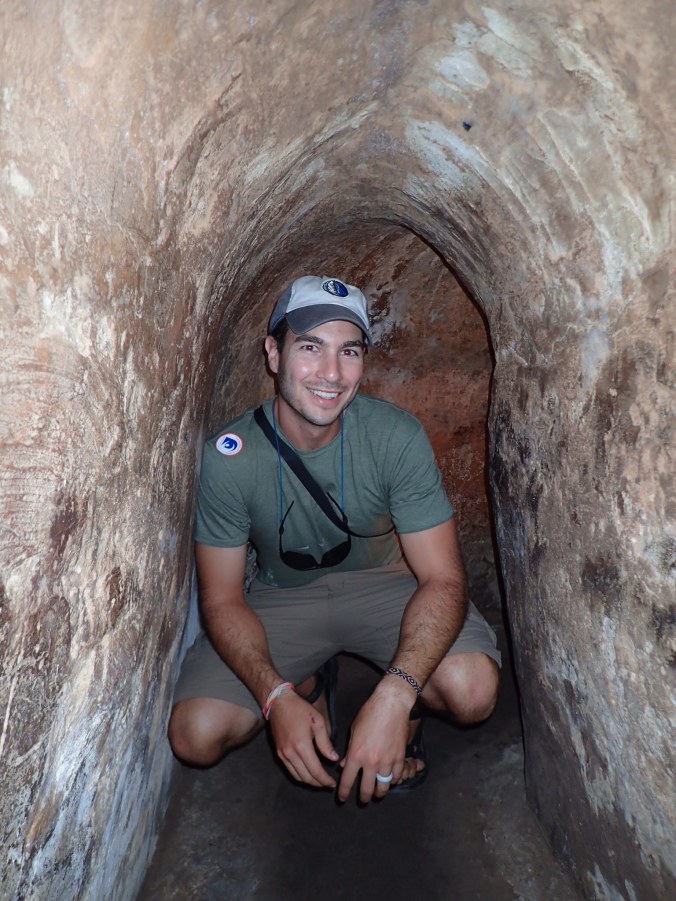
Since we were not big fans of our tour guide, Brandon and I started dropping back to hear the explanations of a different tour guide, and learned how they used termite mounds to keep fresh air moving in and out of the tunnels, and how they filtered smoke away from the kitchens to not give away their positions or tactics. We also saw some of the incredibly treacherous traps they managed to build with minimal supplies. They were terrifying and impressive all at the same time. The one below is just the most basic we saw. Some would tear people to shreds.


After the tunnels, the small group of people that came from our hostel together all wanted to visit the War Remnants Museum where I was surprised to find that almost all the planes and tanks on display were American vessels. I guess I was expecting them all to be Vietnamese? But some of these planes and tanks were incredible. Seeing them like this, they almost look like models, as if the “real” ones would be bigger or scarier or something. But when you look at the sheer size of the planes and the weapons they could carry, it suddenly becomes real.
But what really pulled me in were the stories of the journalists that covered the war. Many say that television and print bringing the war into people’s living rooms is what changed America’s opinions on the war. And these were the stories of the journalists that did that. It was fascinating to read about their lives, their perspectives on what they were doing, and even their deaths. Their job was to cover the war. They were not politicians, or peace keepers, or military. And that made some of what we read hard to swallow.
One story that stuck with me went along with an innocent looking family photo. A mom, children, a grandmother. They were captured by American troops – their photo captured by a journalist. After the photo was taken, the journalist turned and heard the gunshots. None were allowed to survive.
I want the journalist to shout “Wait! Stop! What are you doing?” But they couldn’t. If they did, they would lose their jobs. If they did, they would not be showing us or be able to show us, what was really happening on the other side of the world. The position they were in must have been terrible, armed with only a camera. We spent hours in there (seriously – they kicked us out at closing time) reading these stories, stories about Agent Orange and its effects on the population, and learning more about why we were there, and how the war unfolded. There are not many museums I would revisit, but I think I could go back there and take something new away from it if I had the opportunity to go again.
We learned a little bit more about this time during our visit to the Royal Palace the next day. But for the most part, this was the end of a few heavy and history-filled days.
Coming out of them, we were full of anger and sadness and pain. And we know we will carry that with us in the hope that it helps us teach others and create a dialogue to prevent such atrocities from happening again. With all the hate an unrest happening around the world, and even within the US, it feels more important than ever that we have these conversations to pursue understanding, passion, and peace.
 Brandon & Devon (BaD) Journey